
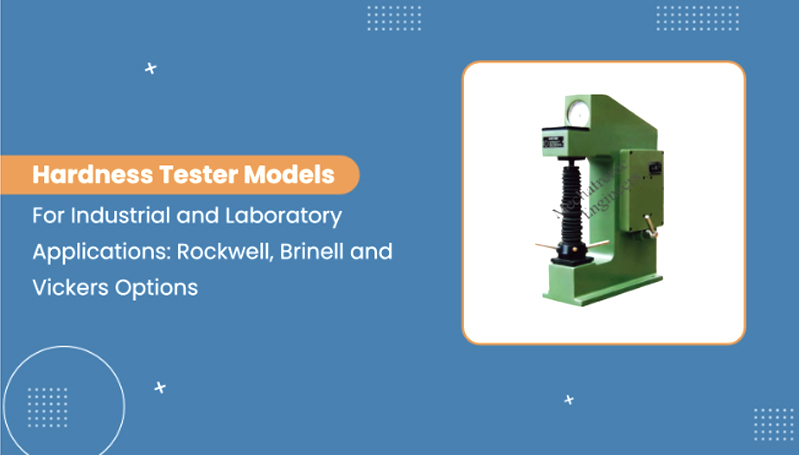
Choosing a hardness tester for an industrial facility or laboratory requires more than comparing machine prices. Buyers need to identify the appropriate testing method, understand the available machine configurations, confirm applicable standards, and determine whether the equipment suits the materials and specimens they intend to test.
Mechatronic Engineers manufactures hardness testing machines for metals and alloys, with Rockwell, Brinell, and Vickers options. Its product range includes standard, digital, hydraulic, optical, computerized, and fully automatic configurations, depending on the testing method. The company also states that it can customize models according to customer requirements.
For procurement teams, quality control departments, metallurgical laboratories, research institutes, technical institutions, and steel industries, the practical question is which machine category best matches the intended application.
This guide compares the actual hardness tester options listed by Mechatronic Engineers, including the ME-RABI-250, ME-RAS, ME-RAS Digital, ME-B-3000 series, and ME-VM-50 series. It explains what buyers should verify before requesting a quotation.
To review the manufacturer’s complete range, visit Mechatronic Engineers Hardness Testing Machines.
Compare Rockwell, Brinell and Vickers Hardness Tester Options
The first purchasing decision is selecting the testing method required for your application. Rockwell, Brinell, and Vickers are distinct hardness testing methods. The correct choice depends on the material, specimen, required testing procedure, and applicable specification.
Mechatronic Engineers offer the following categories.
| Testing Category | Available Options | Examples Listed by Mechatronic Engineers |
| Rockwell | Standard Rockwell, Digital Rockwell, Rockwell Cum Brinell, Rockwell Superficial and Digital Rockwell Superficial | ME-RAS, ME-RAS Digital, ME-RABI-250 |
| Brinell | Manual, Hydraulic, Hydraulic & Optical, Computerized and Fully Automatic Optical/Computerized | ME-B-3000(J), ME-B-3000(H), ME-B-3000(O), ME-B-3000(PC) |
| Vickers | Standard Optical, Computerized, Fully Automatic Optical and Fully Automatic Computerized | ME-VM-50, ME-VM-50 PC |
The listed configurations give buyers several options for matching the testing method to their workflow. However, a particular model should not be selected solely because its name includes a preferred testing method. The buyer should also verify the required hardness scale, specimen geometry, testing procedure, and applicable standard.
For example, Mechatronic Engineers describes its Brinell machines as suitable for castings, forgings, metals, and alloys. Its Vickers ME-VM-50 and ME-VM-50 PC models are described as suitable for precision metallic parts.
Rockwell Hardness Tester Models: Standard, Digital and Combined Options
Rockwell hardness testing is one of the available categories within Mechatronic Engineers’ product range. The company lists standard and digital Rockwell configurations, along with Rockwell Cum Brinell and Rockwell Superficial options.
Buyers should begin by confirming that Rockwell testing is appropriate for their material and that the selected machine supports the required scale and test procedure.
ME-RAS and ME-RAS Digital
Mechatronic Engineers lists the ME-RAS and ME-RAS Digital models for testing metals and alloys, whether hard or soft and whether flat, round, or irregular in shape.
The company describes these machines as simple to operate and designed for sensitive and accurate testing. It identifies engineering colleges, laboratories, tool rooms, inspection departments, and factories among the potential application environments.
The ME-RAS Digital is the option to investigate when a buyer specifically requires a digital Rockwell model. Confirm the precise display, reporting, and other operational requirements with the manufacturer rather than assuming that every digital feature is included.
ME-RABI-250 Rockwell Cum Brinell
The ME-RABI-250 is listed as a Rockwell Cum Brinell hardness tester. This category is relevant to buyers evaluating a machine intended to support both Rockwell and Brinell testing.
The manufacturer describes this model as suitable for metals and alloys of different hardness levels and for flat, round, or irregular specimens. It also lists applications in laboratories, engineering colleges, tool rooms, inspection departments, and factories.
Before selecting a combined machine, buyers should confirm which scales, accessories, test procedures, and configurations are required for their work.
Rockwell Superficial Options
Mechatronic Engineers also lists Rockwell Superficial and Digital Rockwell Superficial configurations. These should be considered when the specified application calls for superficial Rockwell testing.
Do not assume that a standard Rockwell configuration automatically meets a superficial testing requirement. State the required scale and applicable standard when requesting a quotation.
Explore the manufacturer’s Rockwell hardness testing machines to review the listed models.
Brinell Hardness Tester Models for Industrial and Production Testing
A Brinell hardness tester is worth considering when your application involves castings, forgings, metals, alloys, or industrial components that require hardness evaluation over a relatively large indentation area. Mechatronic Engineers offers manual, hydraulic, optical, computerized, and fully automatic Brinell configurations.
The right model depends on your testing volume, preferred measurement method, and documentation requirements.
ME-B-3000(J): Manual Brinell Hardness Tester
The ME-B-3000(J) is designed around a straightforward mechanical arrangement with manual loading and unloading. It is an option for laboratories and production facilities that perform batch testing and do not require a computerized measurement system.
Consider this model if you prefer a mechanically operated machine for routine Brinell testing.
ME-B-3000(H): Hydraulic Brinell Hardness Tester
The ME-B-3000(H) is a hydraulic model intended for production testing. It is suitable for testing castings, forgings, metals, and alloys, including specimens with flat, round, or irregular shapes, subject to appropriate specimen support and test requirements.
For manufacturers carrying out regular hardness inspections, this model is worth evaluating when hydraulic operation is a priority.
ME-B-3000(O): Optical Brinell Hardness Tester
The ME-B-3000(O) combines Brinell testing with optical impression measurement. Its listed configuration includes a 14× magnification optical arrangement that projects the ball impression onto a glass screen, along with a micrometer measuring system with a stated accuracy of 0.01 mm.
This model may suit laboratories that prefer to inspect and measure the indentation through an optical system.
ME-B-3000(PC): Computerized Brinell Hardness Tester
The ME-B-3000(PC) includes a CCD camera, Windows-based software, and USB connectivity. Its software supports Auto, Semi-Auto, and Manual methods for calculating the Brinell hardness number.
Consider this configuration if your laboratory wants computer-assisted impression measurement rather than relying entirely on manual measurement.
Vickers Hardness Tester Models for Precision Metallic Parts
A Vickers hardness tester is another option for laboratories evaluating precision metallic components. The appropriate setup depends on the specimen, required test force, applicable testing procedure, and measurement requirements.
Mechatronic Engineers lists optical, computerized, and fully automatic optical and computerized Vickers configurations.
ME-VM-50: Optical Vickers Hardness Tester
The ME-VM-50 is an optical Vickers hardness tester described by the manufacturer as suitable for precision metallic parts across a wide hardness range, from soft to hard materials.
It is worth considering when you need an optical testing arrangement for laboratory or industrial inspection.
ME-VM-50 PC: Computerized Vickers Hardness Tester
The ME-VM-50 PC is the computerized version of the Vickers tester. It is also listed for precision metallic parts and a wide testing range.
When comparing the optical and computerized models, explain your measurement and reporting requirements to the supplier so the recommended configuration matches your actual workflow.
Fully Automatic Vickers Configurations
Mechatronic Engineers also lists Fully Automatic Optical Vickers and Fully Automatic Computerized Vickers models in its product range. Buyers considering these options should confirm the available model specifications, degree of automation, software functions, and compatibility with their test procedures before ordering.
Explore the Vickers Hardness Testing Machines range to review the available options.
How to Choose the Right Hardness Tester for Your Application
Before purchasing a hardness tester, evaluate these requirements with your quality, production, or laboratory team.
- Identify the testing method. Establish whether Rockwell, Brinell, or Vickers testing is required by your product specification, customer requirements, or applicable test standard. These methods are not automatically interchangeable.
- Describe your specimens. Share the material type, hardness range, specimen dimensions, shape, surface condition, and any practical restrictions on indentation size or location.
- Match the configuration to your workflow. Compare manual, hydraulic, digital, optical, computerized, and fully automatic options according to the features available for each model.
- Estimate testing volume. Explain how many specimens you expect to test per shift, day, or month. This helps the manufacturer assess whether a straightforward manual system or a more automated configuration is appropriate.
- Confirm documentation requirements. If you need digital results, printed output, software-assisted measurement, or records for quality audits, specify those requirements before selecting a model.
- Verify installation and support needs. Ask about calibration, maintenance, accessories, operator training, and after-sales support. Confirm what is included in the quoted supply.
Hardness Tester Standards and Compliance
The applicable standard should be confirmed for the selected testing method, model, and intended application. Mechatronic Engineers lists the following standards across its Rockwell, Brinell, and Vickers product information.
| Testing method | Standards listed by the manufacturer |
| Rockwell | IS: 3804-1988, BS: 891 Parts 1 and 2, ASTM E18 |
| Rockwell Superficial | IS: 5073-1988, ASTM E18 |
| Brinell | IS: 2281-1968, BS: 240, ASTM E10 |
| Vickers | IS: 1754-1968, as listed on the product page |
These references reflect the manufacturer’s published product information. Confirm the current applicable edition, exact model compliance, and any required certificates directly with the manufacturer before purchasing, especially when equipment will be used for regulated testing or customer-mandated quality inspections.
Can Mechatronic Engineers Customize a Hardness Tester?
Yes. Mechatronic Engineers states that it can customize its Rockwell, Brinell, and Vickers hardness testing machine models according to customer requirements.
When requesting customization, provide your material specifications, required test method, specimen dimensions, test volume, preferred measurement arrangement, and reporting needs. This gives the technical team a clearer basis for recommending a suitable configuration.
To discuss a specific application, use the Mechatronic Engineers contact page.
Frequently Asked Questions About Hardness Testers
There is no single best model for every application. The appropriate choice depends on the material, required testing method, specimen geometry, production volume, and applicable standard.
They use different indentation methods and measurement principles. Rockwell determines hardness from indentation depth, Brinell measures the diameter of a ball indentation, and Vickers uses a diamond-pyramid indentation whose diagonals are measured. Select the method required by your material specification or test procedure.
Yes. Its published range includes Digital Rockwell, Computerized Brinell, and Computerized Vickers models. The manufacturer also lists fully automatic options for selected Brinell and Vickers configurations.
Mechatronic Engineers lists a Rockwell cum Brinell model, ME-RABI-250. Whether a multi-method machine is appropriate depends on your required test methods, specimen range, and applicable standards. Confirm the exact configuration with the manufacturer.
Provide your material type, expected hardness range, specimen dimensions and shape, required test method, approximate testing volume, preferred manual or automated configuration, and any standards or reporting requirements. Also mention your location and installation requirements so the supplier can address delivery and support.
Request a Hardness Tester Recommendation
Choosing the right hardness tester starts with understanding your specimens and the testing procedure you need to follow. Mechatronic Engineers offers Rockwell, Brinell, and Vickers hardness testing machines in multiple configurations for industrial, production, inspection, and laboratory applications.
Whether you are evaluating the ME-RAS Digital Rockwell tester, the ME-B-3000 series Brinell machines, or the ME-VM-50 Vickers range, discuss your requirements with the manufacturer before finalizing the model.
Looking for a Hardness Tester? Share your material, required testing method, specimen dimensions, and application with the Mechatronic Engineers team to identify a suitable Rockwell, Brinell, or Vickers configuration.