
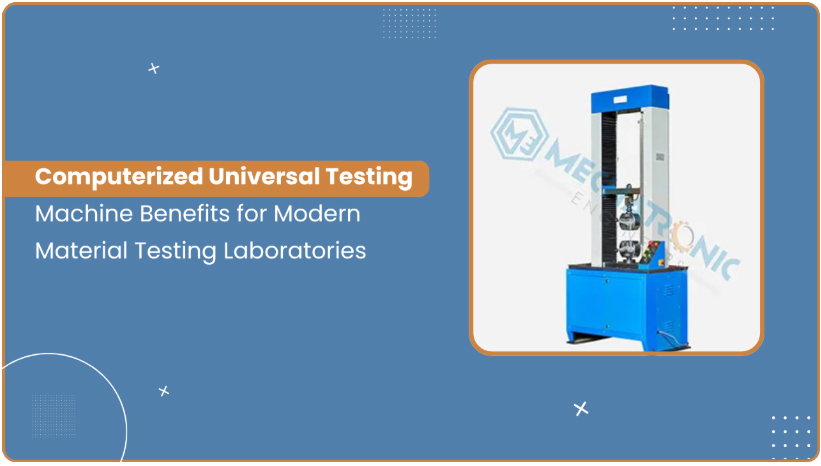
Material testing laboratories today are expected to deliver far more than simple pass-or-fail results. Manufacturers, research institutions, engineering colleges, and quality control teams need accurate, repeatable, and traceable data that supports product development, compliance, and quality assurance initiatives.
Traditional testing systems often rely on manual readings, handwritten records, and operator calculations. While these methods may still provide basic testing functionality, they can increase reporting time, introduce human error, and limit the amount of useful engineering information available for analysis.
A computerized universal testing machine eliminates many of these challenges by combining advanced sensors, digital control systems, extensometers, and software-driven reporting tools into a single testing platform. These machines automatically capture and analyze testing data, allowing laboratories to improve efficiency while gaining deeper insight into material behavior.
As a leading material testing machine manufacturer, Mechatronic Engineers provides advanced testing solutions designed to help laboratories improve accuracy, maintain compliance, and streamline testing workflows.
What is a Computerized Universal Testing Machine?
A computerized universal testing machine is a software-driven material testing system used to evaluate the mechanical properties of materials under controlled loading conditions.
Unlike conventional testing systems that require manual observation and calculations, computerized machines automatically collect, process, analyze, and store test data throughout the testing cycle.
- Tensile Testing
- Compression Testing
- Bend Testing
- Re-Bend Testing
- Transverse Testing
- Shear Testing
- Peel Testing
- Tear Testing
This versatility allows laboratories to test a wide range of materials including metals, plastics, composites, rubber, ceramics, fabrics, wires, and cables using a single platform.
Organizations seeking advanced testing capabilities can explore Mechatronic Engineers’ computerized universal testing machine solutions designed for industrial, educational, and research applications.
Real-Time Data Collection and Analysis
One of the biggest advantages of computerized testing is automatic data collection.
During testing, the software continuously records:
- Force (Load)
- Deflection
- Extension
- Stress
- Strain
- Peak Load
- Yield Point
- Proof Stress Values
Instead of manually recording measurements, operators receive instant access to accurate digital data that can be analyzed immediately.
This significantly improves testing efficiency while reducing the possibility of human error.
Advanced Material Analysis
Modern testing software transforms raw measurements into valuable engineering information.
Engineers can instantly view:
- Stress-Strain Curves
- Yield Strength
- Ultimate Tensile Strength
- Elongation
- Modulus Values
- Proof Stress Measurements
This allows laboratories to understand material behavior more effectively and make informed decisions regarding product performance and quality.
Looking to replace manual testing procedures with automated data collection and advanced reporting? Explore Mechatronic Engineers’ computerized universal testing machine solutions or contact our technical team to discuss your laboratory requirements.
Why Modern Laboratories Are Upgrading to Computerized Universal Testing Machines
Laboratories today face increasing expectations from customers, auditors, certification agencies, and quality teams.
Organizations are expected to deliver highly accurate results while maintaining complete traceability and compliance with industry standards.
Computerized testing systems help laboratories meet these expectations while significantly improving productivity.
Improved Testing Accuracy
Testing accuracy is critical when evaluating engineering materials.
Even small measurement errors can affect:
- Product quality
- Material certifications
- Engineering decisions
- Compliance documentation
- Customer confidence
Computerized systems reduce these risks by automating measurements and calculations.
Benefits include:
- Improved repeatability
- Reduced operator influence
- Consistent test execution
- Greater confidence in results
For laboratories performing customer certifications and quality audits, these advantages can provide substantial operational value.
Faster Report Generation
Many laboratories spend considerable time preparing reports after testing.
Computerized systems automate this process by generating detailed reports immediately after the test is complete.
Reports can include:
- Load Values
- Stress Values
- Strain Values
- Graphs
- Material Properties
- Test Summaries
This allows engineers to spend less time on paperwork and more time analyzing results.
Better Data Traceability
Traceability is essential for quality management systems.
Computerized testing machines automatically store test records, making it easy to retrieve historical data during:
- Quality Audits
- ISO Reviews
- Customer Evaluations
- Product Investigations
- Continuous Improvement Programs
Digital record keeping supports compliance while improving data management across the laboratory.
Need a testing solution that delivers accurate results, automated reports, and complete traceability? Explore Mechatronic Engineers’ computerized universal testing machine solutions and speak with our technical team to identify the right system for your testing requirements.
Applications of Computerized Universal Testing Machines
One of the greatest advantages of a computerized universal testing machine is its versatility.
A single machine can support multiple industries and testing applications.
Manufacturing and Quality Assurance
Manufacturers use computerized testing systems to verify material quality before products reach customers.
Common applications include:
- Incoming Material Inspection
- Production Quality Control
- Product Validation
- Supplier Verification
- Customer Compliance Testing
Automated reporting helps organizations maintain consistency while reducing administrative effort.
Research and Development Laboratories
Research facilities rely on detailed material analysis to evaluate new products and materials.
Computerized testing systems provide the data required for:
- New Alloy Development
- Composite Material Research
- Polymer Testing
- Product Design Validation
- Performance Benchmarking
Advanced software allows researchers to compare materials and identify performance trends with greater accuracy.
Hydraulic vs Motorized Computerized Universal Testing Machines
Choosing the right computerized universal testing machine starts with understanding the difference between hydraulic and motorized systems. While both technologies provide excellent testing capabilities, they are designed for different testing environments, force capacities, and application requirements.
Mechatronic Engineers offers both hydraulic and motorized testing solutions, allowing laboratories to select a system that aligns with their current testing requirements and future growth plans.
Hydraulic Computerized Universal Testing Machines
Hydraulic testing systems are preferred when higher force capacities are required.
Mechatronic Engineers’ hydraulic universal testing machines are available in capacities ranging from 100 kN to 3000 kN (10T to 300T).
These systems are designed for testing:
- Metals
- Structural Components
- Heavy Engineering Materials
- Steel Products
- Industrial Components
They can perform:
- Tensile Tests
- Compression Tests
- Bend Tests
- Re-Bend Tests
- Transverse Tests
- Shear Tests
- Hardness Tests
For laboratories that regularly test high-strength materials, hydraulic systems provide the force and durability required for demanding applications.
ME-UTE Computerized Universal Testing Machine
The ME-UTE series is designed as a standard opening universal testing machine with wedge-action grips for easy specimen handling.
These machines are computerized and equipped with advanced Windows-based software that helps operators analyze test data efficiently.
Key benefits include:
- Digital Testing Platform
- Computerized Reporting
- Advanced Software
- Multiple Test Methods
- Digital Extensometer Compatibility
Using a digital extensometer, laboratories can generate stress-strain curves and determine important mechanical properties such as proof stress and load values at specified strain levels.
Organizations looking for versatile testing capabilities often evaluate the ME-UTE universal testing machine range because it supports a wide variety of industrial testing requirements.
ME-FE-UTE Front Open Hydraulic Gripping System
The ME-FE-UTE model is designed with a front-open crosshead configuration that simplifies specimen loading and unloading.
This design is particularly beneficial when testing large or heavy specimens that may be difficult to position in conventional systems.
Advantages include:
- Front Open Front Loading Design
- Hydraulic Gripping System
- Computerized Operation
- Advanced Windows-Based Software
- Digital Extensometer Integration
The system allows operators to generate stress-strain curves and calculate values such as:
- 0.2% Proof Stress
- Load at Specific Strain Values
- Yield Strength
- Ultimate Tensile Strength
Servo-controlled options are also available for laboratories requiring enhanced precision and control.
Need a high-capacity testing solution for metals and industrial materials? Explore Mechatronic Engineers’ hydraulic universal testing machines or contact our technical team to discuss your testing requirements.
Motorized Universal Testing Machines
While hydraulic systems excel at high-force applications, many laboratories require highly precise testing at lower force capacities.
For these applications, Mechatronic Engineers offers a range of motorized universal testing machines designed for precision testing and research applications.
These machines use electronic screw-driven technology and advanced digital control systems to provide exceptional accuracy and repeatability.
These systems are widely used in QA/QC laboratories, educational institutions, and research environments where precision and flexibility are essential.
Table Top Universal Testing Machines
Laboratories with limited floor space often prefer compact testing solutions.
Mechatronic Engineers’ table-top systems provide:
- High Accuracy
- Advanced Software
- Real-Time Data Processing
- Compact Footprint
- Easy Operation
These machines are particularly suitable for educational institutions, research laboratories, and specialized testing facilities.
How to Choose the Right Computerized Universal Testing Machine
Selecting the right machine requires careful consideration of your testing objectives.
Evaluate Force Requirements
The first step is determining the force range required for your materials.
Heavy engineering applications typically require hydraulic systems, while research and precision testing applications may benefit from motorized systems.
Consider Material Types
Different materials require different testing approaches.
Consider whether you primarily test:
- Metals
- Plastics
- Rubber
- Composites
- Cables
- Fabrics
The selected machine should support all relevant test methods.
Review Software Capabilities
Modern software plays a critical role in laboratory productivity.
Look for systems that provide:
- Automated Reporting
- Stress-Strain Curves
- Data Storage
- Proof Stress Calculations
- Real-Time Analysis
Advanced software can significantly improve testing efficiency and reporting accuracy.
Plan for Future Growth
Many laboratories underestimate future testing requirements.
Investing in a scalable testing platform helps organizations avoid costly equipment upgrades as testing volumes increase.
Not sure which testing system is right for your laboratory? Explore Mechatronic Engineers’ computerized universal testing machine solutions or speak with our technical team for expert guidance.
Frequently Asked Questions (FAQs)
A computerized universal testing machine is a software-driven testing system used to perform tensile, compression, bend, shear, peel, tear, and other mechanical tests while automatically collecting and analyzing test data.
These systems improve testing accuracy, automate report generation, reduce operator error, provide real-time analysis, and maintain complete traceability for quality assurance and compliance purposes.
They are widely used in manufacturing, automotive, aerospace, research laboratories, engineering colleges, quality control facilities, cable manufacturing, plastics testing, and material development applications.
Hydraulic machines are designed for higher force capacities and heavy-duty applications, while motorized machines provide exceptional precision and control for lower-capacity testing and research applications.
Yes. When equipped with advanced software and digital extensometers, these systems can generate real-time stress-strain curves and calculate important mechanical properties automatically.
Upgrade Your Material Testing Capabilities
As testing requirements continue to evolve, laboratories need systems that provide more than basic force measurements. Accuracy, automation, traceability, and advanced analysis have become essential requirements for modern testing environments.
A computerized universal testing machine helps organizations improve efficiency, reduce reporting time, maintain compliance, and gain deeper insight into material performance.
Whether you require a high-capacity hydraulic testing system or a precision motorized solution, Mechatronic Engineers offers advanced testing equipment designed to support industrial, research, and educational applications.
Ready to modernize your laboratory? Explore Mechatronic Engineers’ universal testing machine range or contact our technical team today to discuss the right testing solution for your application.