
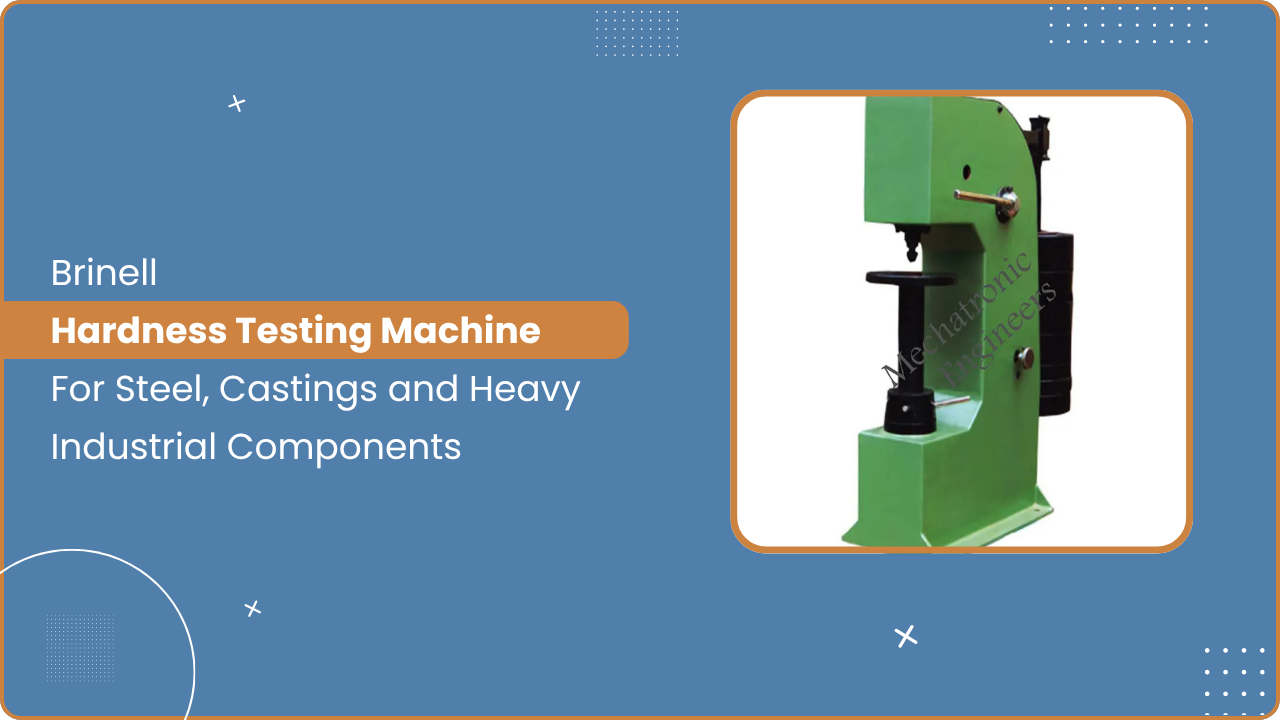
When testing large steel components, castings, forgings, and heavy industrial parts, not every hardness testing method delivers equally reliable results. Materials used in foundries, steel plants, rail infrastructure, heavy engineering, mining equipment, and power generation often have coarse grain structures and large surface areas that require a different approach to hardness testing.
This is where a brinell hardness testing machine continues to play a critical role.
Unlike testing methods that focus on very small impressions, the Brinell method uses a larger ball indenter and higher test loads to create a broader indentation. This allows the test to evaluate a larger area of the material surface, providing a more representative measurement of hardness across castings, forgings, and structural components.
For decades, manufacturers around the world have relied on Brinell testing to verify the hardness of steel products, heavy machinery components, cast iron parts, forged shafts, pressure vessel materials, and industrial equipment.
As a trusted material testing machine manufacturer, Mechatronic Engineers manufactures a complete range of Brinell hardness testing solutions designed for production environments, laboratories, engineering colleges, inspection departments, and research facilities. Their machines are engineered to comply with recognized standards while delivering reliable and repeatable hardness measurements across a wide variety of industrial applications.
Why Brinell Hardness Testing Remains Important in Heavy Industry
Many hardness testing methods work extremely well for small precision components and fine surface evaluations. However, heavy industrial components present unique challenges.
Large castings and forgings often contain variations in grain structure, surface conditions, and material distribution. Testing a very small area may not provide a true representation of the overall material properties.
The Brinell method addresses this challenge by using larger indenters and higher loads. The larger impression averages material characteristics over a broader area, helping manufacturers obtain a more representative hardness value.
- Steel mills
- Foundries
- Forging facilities
- Heavy engineering companies
- Rail infrastructure manufacturers
- Mining equipment manufacturers
- Power generation equipment suppliers
- Industrial fabrication facilities
In these environments, accurate hardness testing is not simply a quality control requirement. It is often a critical factor in product reliability, safety, and performance.
Why Large Indentations Produce Better Results
The larger indentation created during a Brinell test helps reduce the influence of localized material variations.
For example, a casting may contain minor inconsistencies in grain structure. A small indentation may only evaluate a limited area and potentially produce a result that does not represent the overall material.
A Brinell hardness test evaluates a larger section of the surface, helping provide a more accurate representation of the material’s actual hardness.
This is particularly valuable when testing:
- Cast steel
- Cast iron
- Forged shafts
- Structural steel
- Heavy-duty machine components
- Industrial rollers
- Pressure vessel materials
- Large fabricated assemblies
Organizations looking to evaluate different Brinell testing solutions can explore Mechatronic Engineers’ Brinell hardness testing machine range to compare available models and testing capabilities.
What is a Brinell Hardness Testing Machine?
A Brinell hardness testing machine measures the hardness of a material by pressing a hardened ball indenter into the test surface under a specified load. After the load is removed, the diameter of the indentation is measured and used to calculate the Brinell Hardness Number (BHN).
The Brinell method is particularly effective for testing materials that may be difficult to evaluate accurately using smaller-scale testing methods.
Because the indentation covers a larger surface area, the results often provide a better representation of overall material hardness.
This makes Brinell testing highly effective for production testing and heavy industrial applications.
How the Brinell Method Works
The testing process generally follows these steps:
- The specimen is positioned on the testing table.
- A ball indenter is pressed into the material using a specified test load.
- The load is maintained for a defined period.
- The load is removed.
- The diameter of the indentation is measured.
- The Brinell Hardness Number is calculated.
Although the testing principle is straightforward, accurate results depend on using properly calibrated equipment and appropriate test loads.
Standards Commonly Used for Brinell Testing
Industrial buyers often require compliance with recognized testing standards.
Mechatronic Engineers’ Brinell testing machines are precision engineered to standards including:
- IS: 2281-1968
- BS: 240
- ASTM E10
These standards help ensure testing consistency and provide confidence in reported hardness values.
Need a Brinell testing solution that complies with recognized industry standards? Explore the Brinell hardness testing machine range to compare production, optical, and computerized testing options.
Why Steel Manufacturers Prefer Brinell Testing
Steel manufacturers rely heavily on hardness testing to validate production quality, verify heat-treatment processes, and ensure materials meet customer specifications.
Because steel products are often produced in large sections, cast forms, or forged components, the Brinell method provides advantages that smaller-scale testing methods may not offer.
The larger indentation area helps average material characteristics across a broader section of the product, producing results that better represent actual performance.
For steel producers, this helps support:
- Batch consistency
- Quality assurance
- Customer compliance
- Process validation
- Product certification
Many steel manufacturers integrate Brinell testing into routine quality control procedures because it provides dependable results across a wide range of material types and product sizes.
Why Brinell Testing is Ideal for Castings and Forgings
Castings and forgings present unique testing challenges because their internal structures can vary significantly depending on production methods, cooling rates, and material composition.
A testing method that evaluates only a very small area may not accurately represent the entire component.
Brinell testing addresses this challenge through larger indentations and higher test loads, making it particularly effective for:
- Steel castings
- Iron castings
- Forged shafts
- Forged rings
- Heavy industrial parts
- Structural components
- Mining equipment components
- Rail infrastructure components
The ability to generate representative hardness values across these materials is one of the primary reasons Brinell testing remains widely used throughout heavy industry.
Looking for the right Brinell hardness testing solution for steel, castings, or forgings? Speak with our technical team to discuss your testing requirements and application needs.
Industries That Commonly Use Brinell Hardness Testing Machines
The Brinell method has remained a trusted hardness testing solution for decades because it performs exceptionally well across a wide range of heavy industrial applications. Unlike methods primarily suited for small precision components, Brinell testing is designed to evaluate larger materials and structural parts where representative hardness measurements are critical.
Steel Manufacturing
Steel producers use Brinell testing to verify material hardness throughout production and heat-treatment processes. Testing helps ensure steel products meet customer specifications while maintaining consistency across production batches.
Applications include:
- Structural steel
- Steel plates
- Forged components
- Industrial shafts
- Heat-treated products
Foundries
Heavy Engineering
Large industrial components often require reliable hardness verification to ensure durability and performance under demanding operating conditions.
Applications include:
- Industrial rollers
- Machine frames
- Structural assemblies
- Fabricated components
- Mechanical equipment
Mining and Construction Equipment
Mining and construction environments place extreme stress on equipment. Hardness testing helps manufacturers verify wear resistance and material strength before products are deployed.
Applications include:
- Crusher components
- Excavator parts
- Wear plates
- Drilling equipment
- Heavy-duty attachments
Because of these demanding conditions, Brinell testing remains one of the preferred hardness testing methods throughout these industries.
Choosing the Right Brinell Hardness Testing Machine
Not all Brinell testing machines are designed for the same environment. Some facilities prioritize production speed, while others require optical measurement systems or computerized reporting capabilities.
Mechatronic Engineers offers several Brinell testing solutions, allowing organizations to select a machine that aligns with their testing requirements.
Organizations comparing different models can explore the complete Brinell hardness testing machine range to identify the most suitable option for their application.
ME-B-3000(H): Hydraulic Brinell Hardness Testing Machine
The ME-B-3000(H) Brinell Hardness Testing Machine is designed for production testing environments that require efficient loading and unloading operations.
This model features a hydraulic power pack and control circuits that simplify operation while maintaining testing accuracy.
Key advantages include:
- Hydraulic loading and unloading
- Test loads from 500 kgf to 3000 kgf
- Suitable for castings and forgings
- Compliance with ASTM E10, BS 240, and IS 2281
- Production testing capabilities
This machine is particularly useful for organizations performing frequent hardness testing across a variety of industrial materials.
ME-B-3000(J): Mechanical Brinell Hardness Testing Machine
The ME-B-3000(J) Brinell Hardness Testing Machine is the simplest model within the Brinell testing range.
Featuring a mechanical design with manual loading and unloading, it is well suited for facilities seeking a straightforward and cost-effective testing solution.
Benefits include:
- Simple operation
- Manual loading and unloading
- Suitable for batch testing
- Reliable production testing
- Lower complexity
Engineering colleges, laboratories, and facilities with moderate testing requirements often find this model highly practical.
Need a dependable Brinell tester for routine production testing? Explore the ME-B-3000(H) Brinell Hardness Testing Machine or the ME-B-3000(J) Brinell Hardness Testing Machine to compare features and capabilities.
Advanced Brinell Testing Solutions for Greater Accuracy
Some laboratories require more than basic hardness testing. They need enhanced measurement precision, faster reporting, and improved traceability.
For these environments, Mechatronic Engineers offers optical and computerized Brinell testing systems.
ME-B-3000(O): Optical Brinell Hardness Testing Machine
The ME-B-3000(O) Brinell Hardness Testing Machine incorporates an optical measurement system with 14x magnification and a micrometer measuring system capable of 0.01 mm accuracy.
Advantages include:
- Immediate projection of the ball impression
- Improved measurement accuracy
- Reduced operator measurement time
- Enhanced repeatability
- Production testing suitability
Because the optical system allows operators to evaluate impressions immediately after unloading, testing efficiency is improved without sacrificing accuracy.
ME-B-3000(PC): Computerized Brinell Hardness Testing Machine
Organizations seeking advanced reporting and digital analysis capabilities can evaluate the ME-B-3000(PC) Computerized Brinell Hardness Testing Machine.
This model incorporates:
- CCD camera technology
- USB connectivity
- Windows-based software
- Automatic hardness calculation
- Semi-automatic and fully automatic configurations
- Calibration and verification facilities
- Improved reporting capabilities
The computerized system significantly reduces manual measurement requirements while improving consistency and traceability.
These features make it particularly attractive for laboratories, inspection departments, and organizations that require detailed documentation.
What to Consider Before Buying a Brinell Hardness Testing Machine
Selecting the right machine involves more than comparing specifications.
Testing Volume
Facilities performing hundreds of tests per week often benefit from hydraulic or computerized solutions.
Material Types
Castings, forgings, steel plates, and structural components may require different load ranges and measurement capabilities.
Reporting Requirements
Organizations requiring digital records should consider optical or computerized systems.
Compliance Standards
Ensure the machine complies with relevant standards such as ASTM E10, BS 240, and IS 2281.
Service and Calibration Support
Long-term performance depends on proper calibration and technical support.
Organizations should evaluate service capabilities before making a purchase decision.
Not sure which Brinell hardness testing machine is right for your application? Speak with our technical team to receive tailored recommendations based on your materials, testing volume, and operational requirements.
Frequently Asked Questions (FAQs)
Brinell testing uses a larger indentation area, which provides a more representative hardness measurement for materials with coarse grain structures and varying internal characteristics.
Brinell testing is commonly used for steel, cast iron, forgings, structural materials, industrial components, and various metals and alloys.
The machines are precision engineered to standards including IS:2281-1968, BS:240, and ASTM E10.
The ME-B-3000(H), ME-B-3000(O), and ME-B-3000(PC) models are particularly suitable for production testing environments due to their efficiency and advanced capabilities.
Computerized systems automate measurement and reporting processes, improving accuracy, traceability, and productivity while reducing operator dependency.
Improve Quality Control with the Right Brinell Hardness Testing Machine
Brinell hardness testing remains one of the most trusted methods for evaluating steel products, castings, forgings, and heavy industrial components. Its ability to provide representative hardness measurements across large material surfaces makes it indispensable for quality assurance and production testing.
Whether you require a mechanical testing solution, a hydraulic production tester, an optical measurement system, or a fully computerized platform, Mechatronic Engineers offers a comprehensive range of Brinell testing equipment designed to meet diverse industrial requirements.
From the reliable ME-B-3000(J) Brinell Hardness Testing Machine to the advanced ME-B-3000(PC) Computerized Brinell Hardness Testing Machine, Mechatronic Engineers provides solutions built for accuracy, reliability, and long-term performance.
Ready to find the ideal Brinell hardness testing solution for your application? Speak with our technical team and discuss your testing requirements today.