
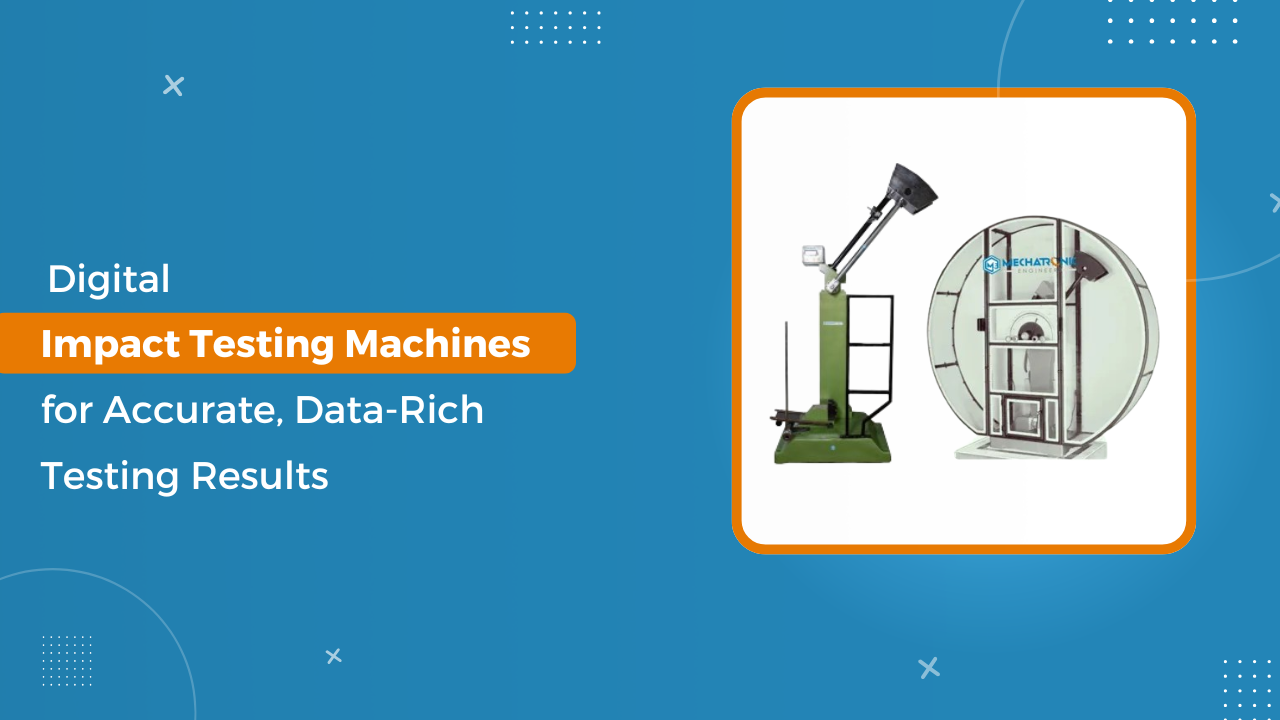
When it comes to material testing, accuracy really matters. Engineers, quality teams, and researchers need more than just a pass-or-fail result-they need clear insight into how a material behaves under impact. While traditional analog machines can show when a sample breaks, they often miss the deeper details. Digital impact testing machines fill this gap by delivering precise, data-driven results that explain not just what happened, but why it happened.
That’s where Digital Impact Testing Machines revolutionize the process. These systems deliver real-time, high-resolution data, turning every test into a source of deep insight.
What is a Digital Impact Testing Machine?
A digital impact testing machine is an advanced instrument that evaluates the toughness of materials by applying a sudden impact force and recording the test results digitally in real-time.
It builds upon the principles of conventional impact tests like Charpy and Izod but integrates digital interfaces, automation, and data analytics. These machines not only record the energy absorbed by the material during impact but also log other critical variables like pendulum velocity, fracture patterns, and environmental conditions.
Key Components
- Pendulum mechanism or instrumented hammer
- High-precision load sensors
- Digital display and control interface
- Software with data logging and reporting tools
- Connectivity options (USB, LAN, ERP/LIMS integration)
Why Are Digital Impact Testing Machines Important?
Because modern quality control and R&D processes demand repeatable, traceable, and data-rich material insights that analog machines simply cannot provide.
Enhanced Accuracy
Digital sensors reduce human error by precisely measuring force, angle, and absorbed energy. Every test is consistent and reproducible.
Seamless Integration
Digital testers connect to ERP, LIMS, and QA dashboards, enabling real-time traceability, reporting, and compliance tracking.
Regulatory Compliance
Complies with global standards like:
Which are required in industries like aerospace, defense, automotive, and construction.
Who Uses Digital Impact Testing Machines?
These machines are essential in high-stakes environments where failure is not an option.
Automotive & EV Sector
- Testing bumpers, chassis, dashboards, and battery casings
- Verifying crash resistance and material ductility
Aerospace & Defense
- Composite wings, fuselage panels, turbine blades
- Ensures high strength-to-weight ratio and impact resilience
Material Science Labs
- Comparative studies for new alloys, composites, and polymers
- Enables fatigue testing and ductile-brittle transition analysis
Civil Engineering & Construction
- Structural beams, rebar, and fasteners
- Compliant with seismic safety regulations and impact load testing
Manufacturing QA
- Batch-wise quality checks in production environments
- Prevents downstream product failures and warranty claims
What Makes Mechatronic’s Digital Impact Testing Machines Stand Out?
Mechatronic Engineers is a trusted name in precision testing. Their digital machines are built for accuracy, reliability, and usability.
Feature Highlights
- Energy Range Flexibility: From 50 J to 750 J depending on material requirements
- Motorized Pendulum Lifting: Reduces operator strain and test cycle time
- Magnetic Braking System: Improves repeatability and safety
- Touchscreen Control Panel: Easy test setup with intuitive interface
- Real-Time Graphing: See fracture curves and impact force instantly
- Auto-Generated Reports: Customizable formats for regulatory submissions
Safety Systems
- Transparent acrylic safety shield
- Interlock-enabled access doors
- Overload protection mechanisms
Comparison: Digital vs Analog Impact Testing Machines
| Feature | Analog Tester | Digital Impact Testing Machine |
|---|---|---|
| Measurement Accuracy | Manual / Analog dial | High-precision digital sensors |
| Data Logging | Manual notes | Auto data capture & export |
| Operator Dependency | High | Minimal |
| Integration with QA Software | Not available | ERP / LIMS compatible |
| Report Generation | Manual | Instant, formatted reports |
| Test Cycle Time | Longer | Faster with automated features |
Pro Tip: If your lab handles multiple test cycles daily, digital testers can cut testing time by up to 40% compared to analog units.
What to Consider When Buying a Digital Impact Testing Machine?
Choosing the right system is about more than price-it’s about aligning with your material type, compliance needs, and testing volume.
Where Digital Impact Testing Makes a Measurable Difference
Automotive Crash Testing
An OEM supplier used Mechatronic’s 450 J digital system to validate bumper components. With real-time graphs and instant reports, they reduced test time by 50%, enabling faster time-to-market for new models.
R&D Lab Material Development
A polymer lab testing new thermoplastic blends needed 200+ tests/week. Using Mechatronic’s digital unit with automated test cycles, they:
- Saved 10 hours/week in operator time
- Eliminated manual data errors
- Created comparative studies using exported graphs
Third-Party Certification Labs
Accredited labs that validate compliance for clients use these machines for:
- ISO test certification
- Pre-export quality audits
- Material performance guarantees
Benefits of Upgrading to a Digital System
✔ Repeatability – Every test is identical in execution
✔ Faster Test Cycles – Up to 30% faster in high-throughput labs
✔ Full Traceability – Ideal for audits and certifications
✔ Operator Safety – Enclosures, auto-stop pendulums
✔ Better Decision-Making – Data-driven engineering insights
Frequently Asked Questions (FAQs)
Digital testers provide real-time data capture, automation, and software integration, whereas analog machines rely on manual recording and interpretation.
This makes digital systems more accurate, efficient, and suitable for high-throughput and regulated environments.
Yes. Many digital machines from Mechatronic Engineers support interchangeable fixtures for both Charpy and Izod configurations.
This flexibility is essential for labs testing both metals and polymers.
Absolutely. Mechatronic’s systems are built with ERP/LIMS integration in mind, allowing real-time data syncing and automated reporting.
Most manufacturers recommend annual calibration, but frequency can vary depending on usage. Mechatronic Engineers provides calibration kits and service support.
Yes. The machines are built with rugged enclosures, dust-proof controls, and industrial-grade components, ensuring long-term reliability even in tough production floors.
Equip Your Lab with Precision Testing Tools
Upgrading to a Digital Impact Testing Machine isn’t just a step forward-it’s a leap in testing precision, efficiency, and compliance. As material sciences evolve and industry regulations tighten, having a reliable, data-rich system ensures that you’re not just testing… you’re validating with certainty.
Whether you’re running a production QA lab, innovating in R&D, or certifying products for global markets-Mechatronic Engineers’ digital systems are your partner in high-stakes material testing.
Experience the future of impact testing – reach out to learn more about our Digital Impact Testing Machines.