
Quality assurance is no longer limited to measuring dimensions, checking surface finishes, or verifying hardness values. Modern manufacturers must ensure that materials can withstand real-world operating conditions, including sudden shocks, impacts, collisions, and dynamic loads.
A component may pass hardness testing, tensile testing, and dimensional inspection yet still fail when subjected to an unexpected impact. Such failures can result in costly recalls, warranty claims, equipment damage, safety incidents, and reputational risks.
This is why impact testing has become an essential part of quality assurance programs across industries such as automotive manufacturing, steel production, heavy engineering, aerospace, research laboratories, and educational institutions.
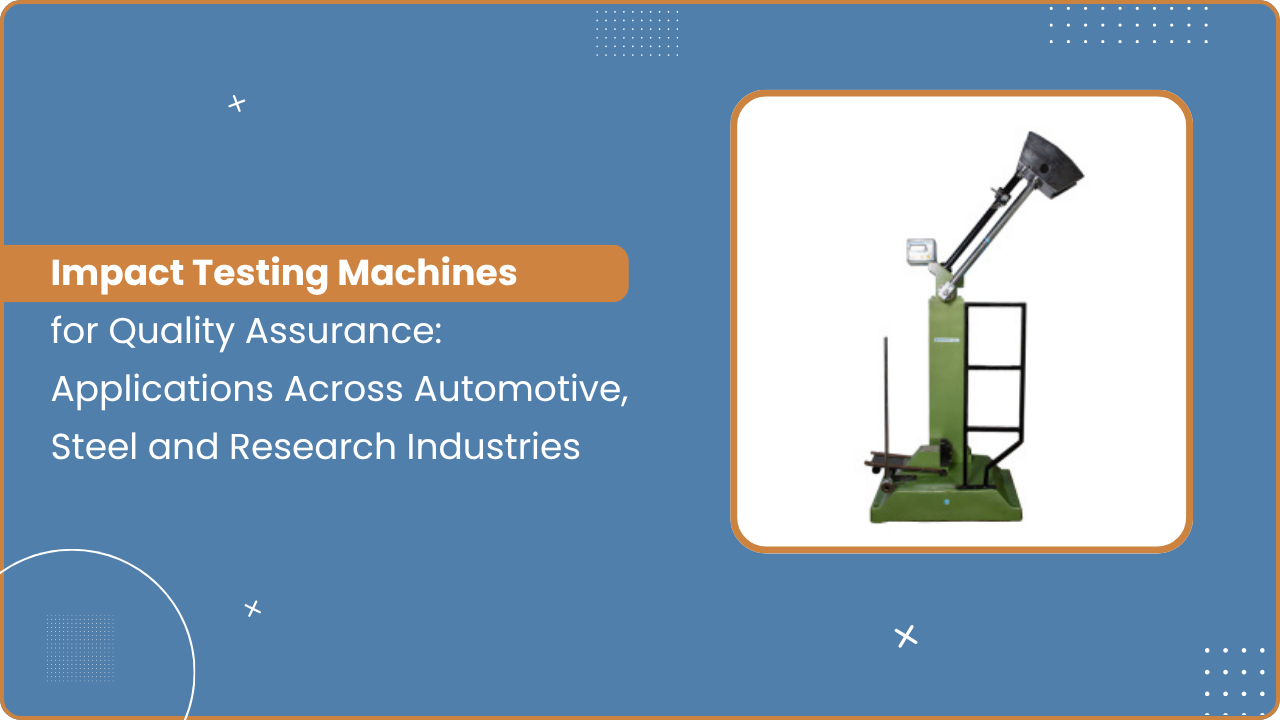
An impact testing machine helps organizations evaluate how materials behave when subjected to sudden force. By measuring the amount of energy absorbed during fracture, manufacturers can better understand material toughness and determine whether a material is suitable for its intended application.
As a trusted material testing machine manufacturer, Mechatronic Engineers provides impact testing solutions designed to help organizations improve quality control, verify material performance, and reduce the risk of product failure. Their impact testing systems are used across laboratories, engineering colleges, research facilities, steel plants, and industrial manufacturing environments where material reliability is critical.
Why Material Toughness Matters in Modern Manufacturing
Many organizations focus heavily on strength and hardness when evaluating materials. While these properties are important, they do not provide a complete picture of how a material will perform in service.
Material toughness measures a material’s ability to absorb energy before fracturing. This property becomes especially important when products are exposed to sudden impacts, shock loading, collisions, vibrations, or rapidly changing operating conditions.
- A vehicle component may experience sudden impact forces during a collision.
- A steel structure may face dynamic loading during operation.
- Industrial machinery may encounter shock loads during production.
- Mining equipment may be subjected to repeated impacts from heavy materials.
In these situations, materials that lack sufficient toughness can fracture unexpectedly, even if they possess acceptable strength or hardness values.
Impact testing allows engineers and quality teams to evaluate these risks before products enter service.
The Cost of Material Failure
Unexpected material failure can create significant consequences for manufacturers and end users.
Common outcomes include:
- Product recalls
- Warranty claims
- Production downtime
- Equipment damage
- Safety incidents
- Increased maintenance costs
- Customer dissatisfaction
Because of these risks, organizations increasingly incorporate impact testing into their quality assurance processes to verify material performance before products reach the market.
Toughness Versus Hardness
One of the most common misconceptions in manufacturing is assuming that a harder material is automatically a better material.
In reality, hardness and toughness measure different properties.
Hardness indicates resistance to indentation and wear.
Toughness indicates the ability to absorb energy before fracture.
A material may exhibit excellent hardness but poor toughness, making it vulnerable to sudden cracking under impact conditions.
This is why many industries combine hardness testing, tensile testing, and impact testing to gain a complete understanding of material performance.
How Impact Testing Works
The operating principle of an impact testing machine is straightforward but highly effective.
The specimen is prepared according to established testing standards and positioned within the machine.
A pendulum hammer is raised to a predetermined height and released.
As the pendulum swings downward, it strikes the specimen and fractures it.
The machine measures the difference between:
- The energy before impact
- The energy remaining after fracture
The difference represents the energy absorbed by the material during failure.
This value provides a direct indication of material toughness.
Mechatronic Engineers’ impact testing systems are designed to perform both Izod and Charpy testing methods while complying with recognized standards such as:
- BS : 131 : Part 4-1972
- BSEN : 10045-2 : 1993
- ASTM : E-23-94a
Charpy and Izod Testing Methods
Two of the most widely used impact testing methods are Charpy and Izod testing.
Charpy Testing
In the Charpy test, the specimen is positioned horizontally between supports. The pendulum strikes the center of the specimen, and the energy required to fracture it is measured.
Charpy testing is commonly used for:
- Structural steel
- Pressure vessel materials
- Pipelines
- Heavy industrial components
- Steel manufacturing
Izod Testing
In the Izod test, the specimen is clamped vertically and struck by the pendulum.
Izod testing is often used for:
- Plastics
- Composites
- Engineering materials
- Research applications
Because both testing methods evaluate toughness differently, many laboratories require equipment capable of performing both tests.
Why Impact Testing is Essential for Quality Assurance
Impact testing provides critical information that cannot be obtained through hardness or tensile testing alone.
By understanding how materials behave under sudden loading conditions, organizations can make more informed decisions about product design, material selection, and quality control.
Detecting Material Weaknesses Before Failure
Small material defects may not always appear during routine inspections.
However, impact testing can reveal weaknesses that may contribute to premature failure when products encounter sudden loads.
This allows manufacturers to identify issues before products reach customers.
Supporting Compliance with Industry Standards
Many industries require material testing procedures that comply with recognized standards.
Impact testing helps organizations demonstrate compliance while providing documented evidence of material performance.
This is particularly important for:
- Automotive manufacturers
- Steel producers
- Aerospace suppliers
- Construction material manufacturers
- Research organizations
Reducing Warranty and Failure Costs
Product failures often lead to significant financial consequences.
By verifying material toughness before production or shipment, organizations can reduce the likelihood of failures occurring in the field.
This helps improve customer satisfaction while protecting brand reputation.
Looking to strengthen your quality assurance program and verify material toughness with confidence? Explore Mechatronic Engineers’ impact testing machine range to identify the right testing solution for your laboratory, production facility, or research organization.
Impact Testing Applications in the Automotive Industry
The automotive industry relies heavily on impact testing because vehicle components must perform safely under demanding conditions.
Manufacturers routinely evaluate materials used in:
- Chassis components
- Suspension systems
- Structural reinforcements
- Crash protection systems
- Electric vehicle battery enclosures
- Automotive fasteners
Impact testing helps engineers determine whether materials can absorb energy effectively during collisions and sudden loading events.
Because vehicle safety depends heavily on material behaviour during impact, toughness testing remains an essential part of automotive quality assurance.
Impact Testing Applications in Steel Manufacturing
Steel manufacturers use impact testing to evaluate the toughness of materials before they are supplied to customers or incorporated into finished products.
Applications include:
- Structural steel
- Forgings
- Pipelines
- Pressure vessels
- Industrial machinery
- Construction materials
By measuring energy absorption characteristics, steel producers can verify that materials meet customer specifications and industry requirements.
Organizations supplying steel to safety-critical industries often view impact testing as a mandatory quality assurance step rather than an optional testing procedure.
Need help selecting the right impact testing solution for your steel plant, laboratory, or manufacturing facility? Speak with our technical team to discuss your application requirements and testing objectives.
Impact Testing in Research Laboratories and Educational Institutions
Impact testing is not limited to manufacturing environments. Research laboratories, engineering colleges, metallurgical institutes, and material science departments also rely heavily on impact testing to understand material behaviour and fracture characteristics.
Researchers often use impact testing to compare materials, evaluate heat-treatment processes, investigate failures, and develop new alloys or composite materials. The ability to measure energy absorption provides valuable insight into how different materials respond under dynamic loading conditions.
Engineering students also benefit from hands-on experience with impact testing equipment because it helps them understand concepts such as:
- Ductile and brittle fracture
- Energy absorption
- Material toughness
- Fracture mechanics
- Charpy and Izod testing methods
- Quality control procedures
By observing real-world test results, students gain practical knowledge that complements theoretical engineering education.
Research facilities and educational institutions looking for reliable testing equipment can evaluate Mechatronic Engineers’ impact testing machine range to support both academic and industrial testing applications.
Standard Impact Testing Machines vs Motorized Impact Testing Machines
One of the most common questions buyers ask is whether they should choose a standard impact testing machine or invest in a motorized system.
The answer depends on testing frequency, productivity requirements, operator workload, and reporting needs.
Standard Impact Testing Machines
The Impact Testing Machine range offered by Mechatronic Engineers includes models designed for conducting both Izod and Charpy tests.
Available models include:
- ME-IT30 Standard Analog Model
- ME-IT30-D Digital Model
- ME-ASTM-E-23 ASTM Analog Model
- ME-ASTM-E-23 D ASTM Digital Model
These machines are designed to conduct impact tests in accordance with:
- BS : 131 : Part 4-1972
- BSEN : 10045-2 : 1993
- ASTM : E-23-94a
Key advantages include:
- Reliable performance
- Dual Charpy and Izod capability
- Analog and digital options
- ASTM-compliant models
- Proven testing methodology
The standard impact testing machine is often a suitable choice for laboratories and facilities performing moderate testing volumes.
Motorized Impact Testing Machines
Organizations performing frequent testing often benefit from automation.
The Motorized Impact Testing Machine range is designed to improve productivity while reducing operator fatigue.
Available models include:
- ME-IT30-M Motorized Analog Model
- ME-IT30-D-M Motorized Digital Model
- ME-ASTM-E-23-M Motorized ASTM Model
These systems offer several advantages:
Motorized Pendulum Lifting
Frequent manual lifting of a pendulum hammer can be physically demanding. The motorized system eliminates this challenge and improves operational efficiency.
Faster Testing Cycles
Because the pendulum lifting process is automated, testing can be performed more quickly and consistently.
Improved Operator Safety
The machines include:
- Large safety guards
- Interlocking door systems
- Transparent acrylic protection
- Magnetic braking systems
These features help create a safer testing environment.
Reduced Maintenance Requirements
The motorized impact testing machine is designed as a low-maintenance solution suitable for demanding industrial environments.
Organizations conducting large numbers of tests each week often find motorized systems provide significant productivity benefits.
Need higher testing throughput and reduced operator fatigue? Explore the Motorized Impact Testing Machine range to improve efficiency and safety in your testing facility.
How to Choose the Right Impact Testing Machine
Selecting the right impact testing machine requires more than comparing specifications.
Buyers should evaluate several important factors before making a decision.
Material Types
The first consideration is the material being tested.
Examples include:
- Structural steel
- Forgings
- Castings
- Automotive materials
- Polymers
- Composite materials
Different applications may require different testing methods and energy capacities.
Testing Standards
Many industries require compliance with recognized standards.
Mechatronic Engineers’ impact testing machines are designed to support standards including:
- ASTM E-23
- BSEN ISO 148
- BS : 131 : Part 4
Ensuring compliance helps organizations satisfy customer and regulatory requirements.
Energy Capacity Requirements
Not all materials require the same testing capacity.
Mechatronic Engineers offers systems capable of:
- 300 Joules
- 400 Joules
- 500 Joules
- 600 Joules
- 750 Joules
Selecting the appropriate capacity ensures accurate and meaningful test results.
Testing Volume
Organizations performing occasional testing may find standard models sufficient.
Facilities conducting large numbers of tests often benefit from motorized systems that improve efficiency and reduce operator workload.
Service and Calibration Support
Long-term performance depends on regular calibration and technical support.
Organizations should consider:
- Service availability
- Calibration support
- Spare parts access
- Technical expertise
Choosing an experienced supplier helps maximize equipment reliability and lifespan.
Not sure which impact testing machine is right for your application? Speak with our technical team to discuss your materials, testing standards, and production requirements.
Common Mistakes Organizations Make When Implementing Impact Testing
Even organizations that understand the importance of impact testing can make mistakes that reduce the effectiveness of their quality assurance programs.
Skipping Impact Testing Entirely
Some manufacturers rely only on hardness or tensile testing. While these tests provide valuable information, they do not evaluate material toughness under sudden loading conditions.
Choosing the Wrong Energy Capacity
Selecting a machine with insufficient testing capacity can lead to inaccurate or incomplete results.
Ignoring Compliance Requirements
Failure to follow required testing standards can create certification and customer acceptance issues.
Delaying Calibration
Poor calibration practices can compromise testing accuracy and reduce confidence in results.
Underestimating Future Testing Needs
Organizations often purchase equipment based solely on current requirements rather than future growth.
Planning ahead can help avoid costly equipment upgrades later.
Frequently Asked Questions (FAQs)
An impact testing machine measures the amount of energy a material absorbs before fracturing under sudden impact loading. This provides valuable information about material toughness.
Steel products are often subjected to dynamic loads and sudden impacts during service. Impact testing helps verify that materials possess adequate toughness and fracture resistance.
Calibration frequency depends on usage levels and quality requirements. Many organizations perform annual calibration, while heavily used equipment may require more frequent verification.
Improve Quality Control with the Right Brinell Hardness Testing Machine
Brinell hardness testing remains one of the most trusted methods for evaluating steel products, castings, forgings, and heavy industrial components. Its ability to provide representative hardness measurements across large material surfaces makes it indispensable for quality assurance and production testing.
Whether you require a mechanical testing solution, a hydraulic production tester, an optical measurement system, or a fully computerized platform, Mechatronic Engineers offers a comprehensive range of Brinell testing equipment designed to meet diverse industrial requirements.
From the reliable ME-B-3000(J) Brinell Hardness Testing Machine to the advanced ME-B-3000(PC) Computerized Brinell Hardness Testing Machine, Mechatronic Engineers provides solutions built for accuracy, reliability, and long-term performance.
Ready to find the ideal Brinell hardness testing solution for your application? Speak with our technical team and discuss your testing requirements today.